
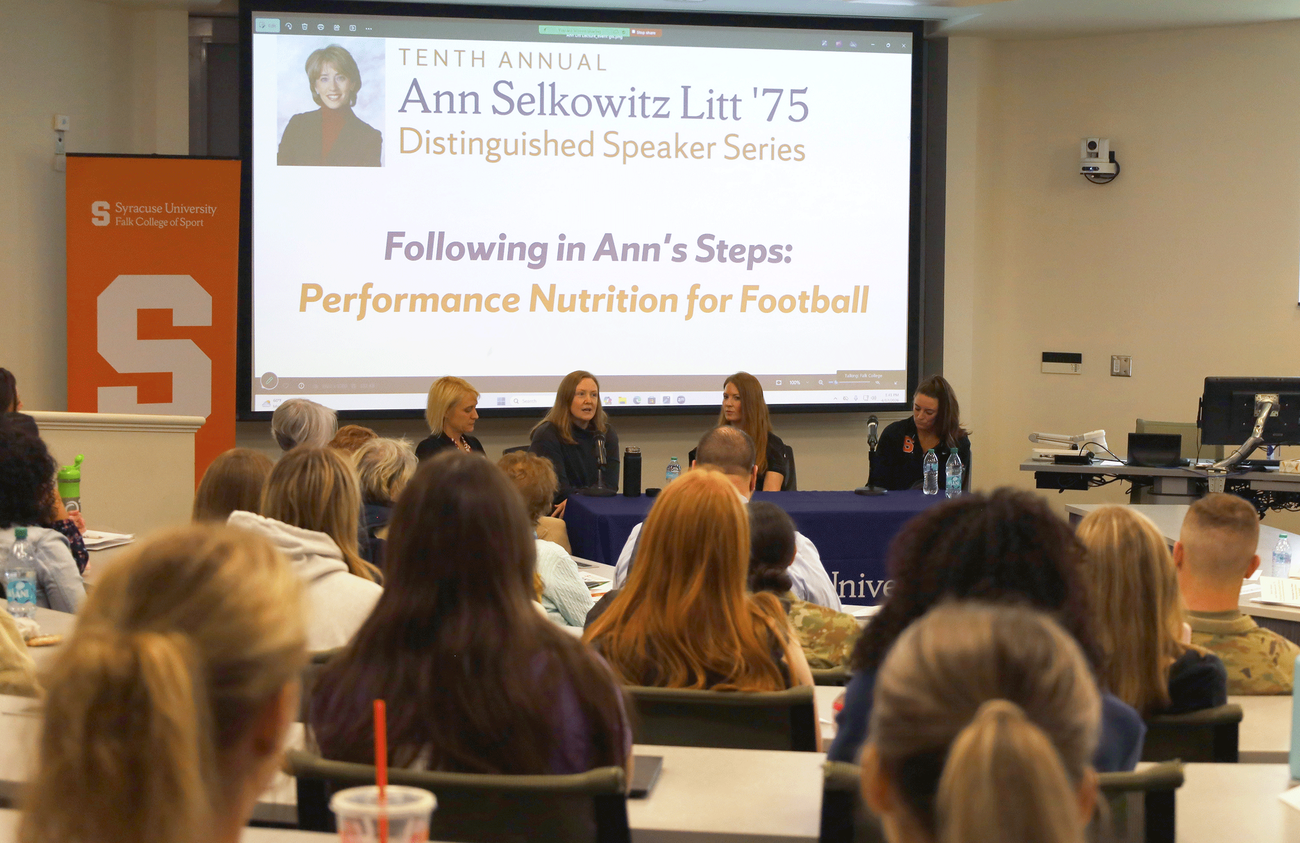
When Sarah Snyder was a high school swimmer in the early 2000s, the nutrition advice available to her was scarce. "I knew to hydrate and take in some whole grains, and that was really it," she recalled. Two decades later, Snyder is the sports dietitian for the Baltimore Ravens, one of 30 full-time NFL dietitians now employed across the league. That number, she noted, was zero not so long ago.
Snyder joined Julia Zalewski, Director of Performance Nutrition for Football at Syracuse University, and Christine Dziedzic, Team Sports Nutrition Dietitian for the Buffalo Bills, for the 10th Anniversary panel of the Ann Selkowitz Litt ’75 Distinguished Speaker Series at the Falk College of Sport. Moderated by teaching professor Jane Burrell, the conversation ranged from game day logistics to motivational interviewing, supplement myths, and what it means to build a career in a field that is still, as Dziedzic put it, "a very young science."
Three Paths, One Profession
No two career trajectories among the panelists looked alike, and that was precisely the point.
Zalewski came up through a coordinated graduate program at the University of Utah, one of only a handful in the country focused specifically on sports nutrition. She worked at New Mexico State, the University of Tulsa, and the University of Arkansas, where a staff shake-up led to an unexpected pivot into a role with the U.S. Air Force. "Being let go actually gave me time to pivot and discover the tactical side of things," she said. "It's not always talked about, but [losing your job] can happen to you, and it doesn't have to define you."
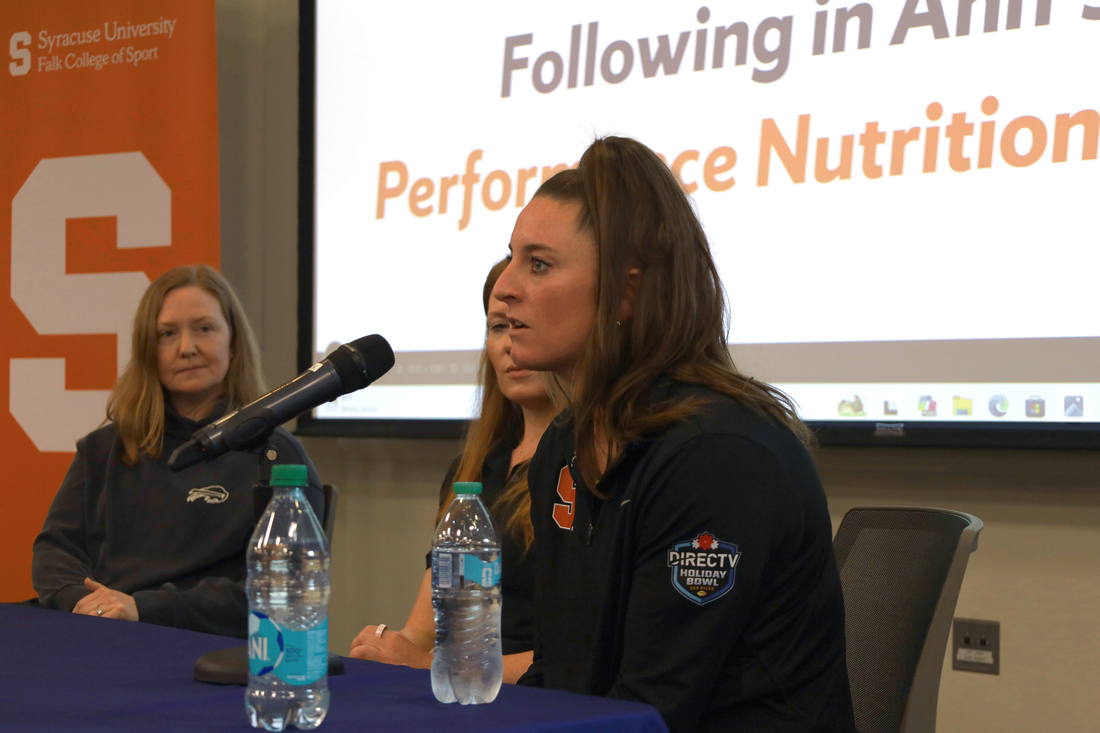
Julia Zalewski, Director of Performance Nutrition for Football at Syracuse University
Dziedzic's path began in Brisbane, Australia, wound through the Australian Institute of Sport under renowned researcher Louise Burke, and eventually brought her to Canada to help prepare athletes for the 2016 Rio Olympics. Then, the Buffalo Bills came calling. For a time, she worked for both the Buffalo Sabres and Buffalo Bills, before ultimately moving full-time to the latter. "I'm just a kid from Brisbane, and I'm working for the Buffalo Bills," she said. "You honestly never know where things might take you, and you should not be afraid to go off course a little bit."
Snyder's journey ran through Florida State, the training facility network Exos, the University of Florida, the University of Michigan, and the Detroit Lions before landing her in Baltimore. She was deliberate about seizing her opportunity when the opportunity with the Lions came about. "As a female, I didn't know if I would have another opportunity to get into the NFL," she said. "So, I took it."
Game Day: Planning a Wedding Every Week
When Burrell asked about game day responsibilities, the answers revealed an operation far more complex and logistically demanding than most fans would imagine.
Zalewski described the scope plainly: "It's a little bit of an operational food service function, and then there's the individual player function." On road trips, she is coordinating hotel menus, reading banquet event orders that run forty pages, and managing everything from arrival snacks to pregame meals to post-game recovery. "There's a lot that goes behind the scenes," she said. "It's almost like planning a wedding every week."
Snyder emphasized the emotional and competitive investment the job requires. "I don't think we would put this much blood, sweat, and tears into our job if we weren't competitive people trying to help these guys be as competitive as they can be." She described sideline work as managing hundreds of individual preferences simultaneously — from hydration monitoring to knowing that one player wants sour patch kids without the red flavor. "If you don't have that item and the player is looking at you, that's a loss," she said.
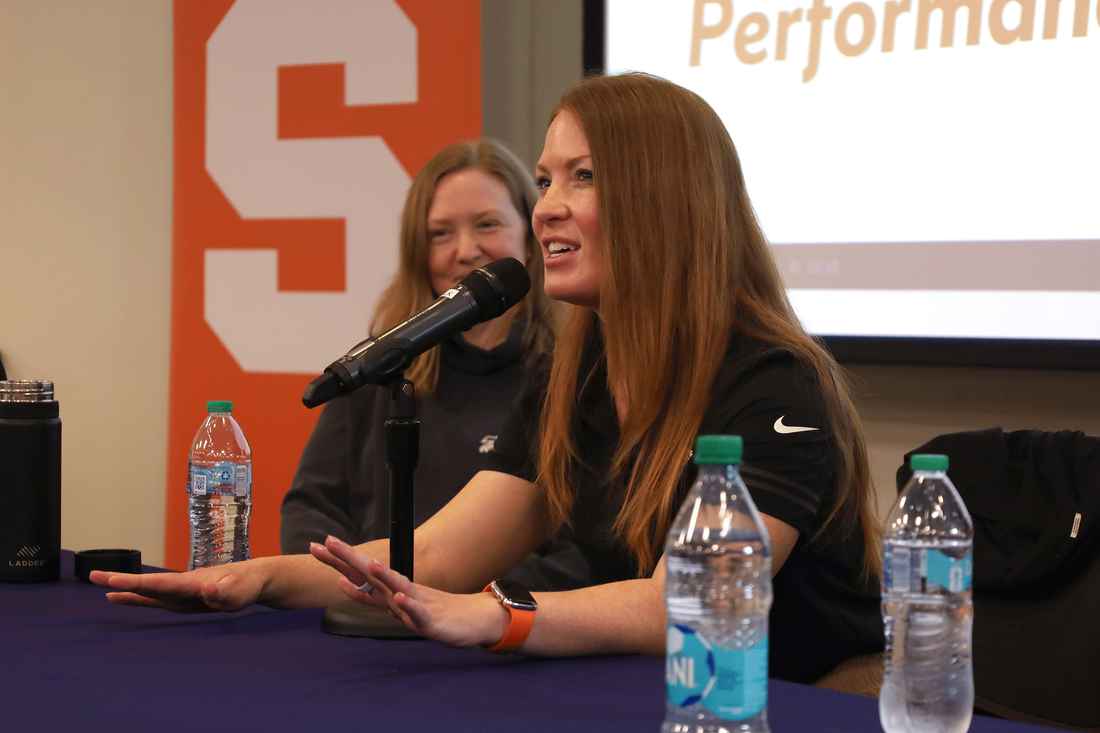
Sarah Snyder, Director of Sports Nutrition, Baltimore Ravens
For Dziedzic, the goal on game day is near-invisibility. "My motto is: be everywhere for everyone, but never really be remembered," she said. "If you've done all of your planning through the week, you can actually be adding to the energy and be part of that moment rather than scrambling to do your job."
The Science Beneath the Service
The panel made clear that sports dietitians are not simply menu planners. They manage chronic conditions, track biomarkers, work with team physicians, and navigate the medical complexity of bodies that defy conventional clinical expectations.
Dziedzic described the NFL's annual physical as a launching point for individualized nutritional assessment, where biomedical data, body composition, and coaching staff expectations are synthesized into a personalized plan. She noted one of the field's recurring surprises: "You wouldn't necessarily think a 390-pound person is going to be healthy, but in fact, a lot of their markers can be leading that way. Genetically, they're gifted, and they're meant to be football players."
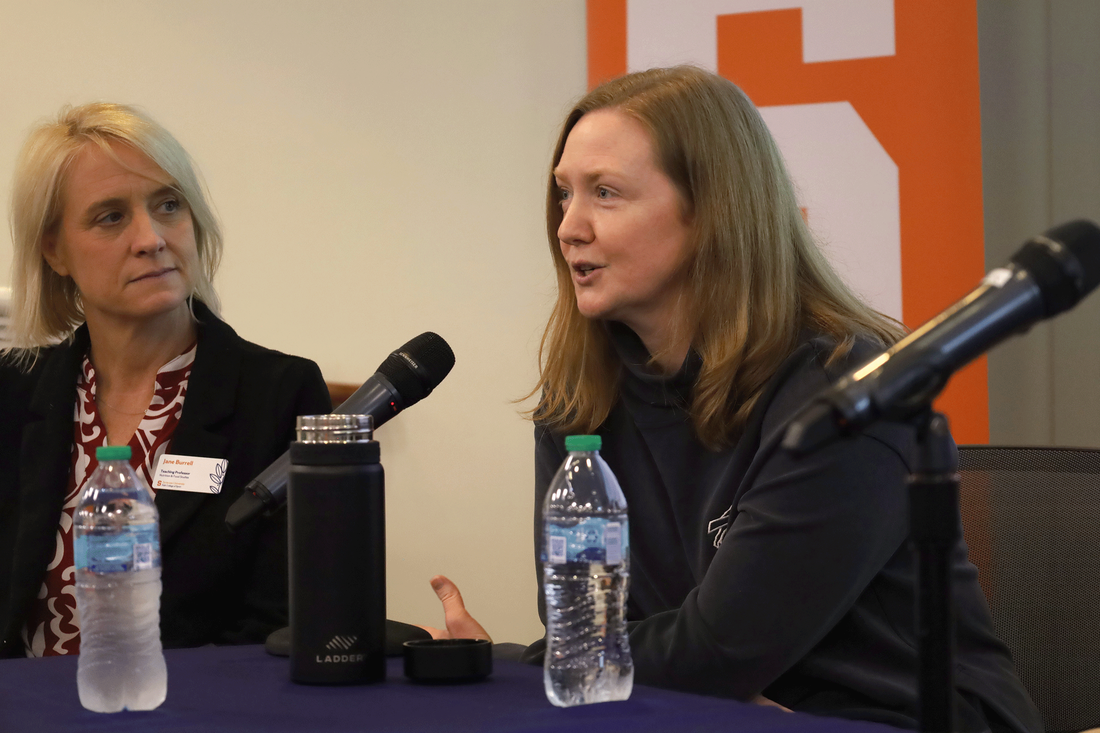
Christine Dziedzic, Team Sports Nutrition Dietitian for the Buffalo Bills
Snyder works with players managing Type 1 diabetes, food allergies, and GI conditions exacerbated by the stress and anxiety of high-stakes competition. She highlighted the Ravens' Mark Andrews, who is open about his journey as a professional athlete with Type 1 diabetes, as a powerful example for younger athletes. "To see him talk about his success with it is really cool," she said.
Buy-In, Behavior, and the McDonald's Principle
All three panelists emphasized that the science matters far less if athletes don't trust the person delivering it.
"Once they know you care, that's a huge piece of it," Snyder said. "If you're just executing and trying to get a number, I don't see that working." She described a non-judgmental approach to eating habits that might raise eyebrows elsewhere. "I have a player who likes McDonald's and eats McDonald's. I'm not judging it. I'm saying: you're getting a carbohydrate and a protein, your body composition is staying consistent, and you're doing other things that are really good. This is okay right now."
Dziedzic leans heavily on motivational interviewing, a technique in which the practitioner guides the athlete to arrive at conclusions themselves. "I'm not actually telling them what to do very much at all," she said. "We discuss, we walk through it: what do you think? How do you think that's going to help? And when they align on that, you're just helping them walk through the steps, and then they're doing the work for you. That's the best outcome."
Zalewski added that presence is often the most underrated tool in a dietitian's arsenal. Walking through the weight room, sending a text to remind a player to pack a third meal, showing up consistently without being asked are small acts that accumulate into the kind of trust that makes the larger interventions possible.
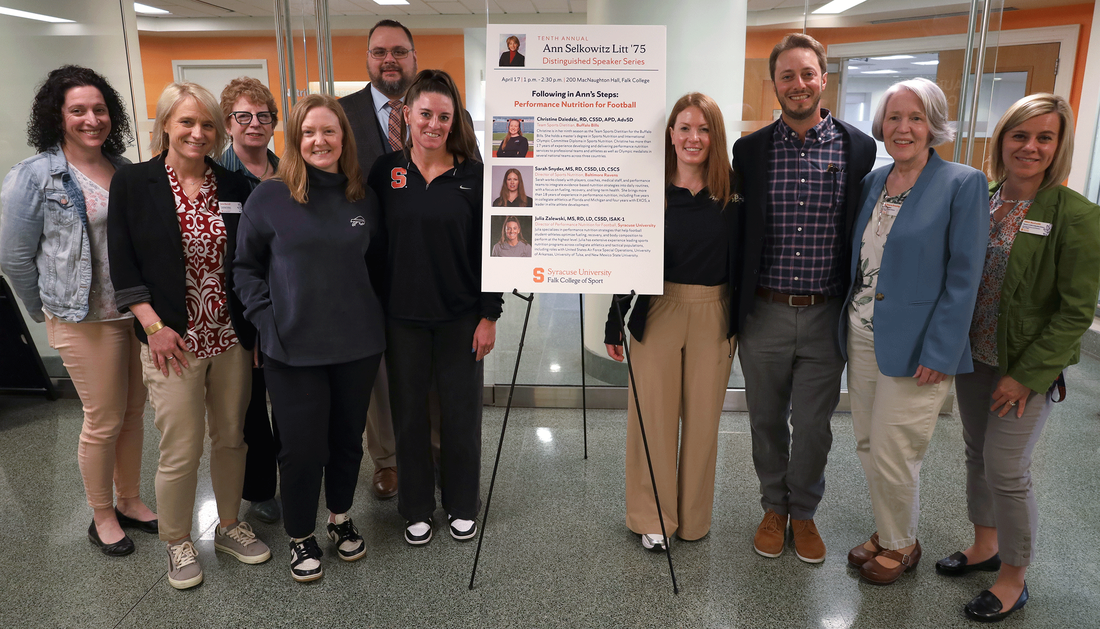
Falk College of Sport faculty members from the Department of Nutrition of Food Studies join the three panelists and Jordan Litt, third from right, son of Ann Litt.
Navigating a Male-Dominated Space
Asked about the experience of being women in a predominantly male sport and industry, the three offered perspectives shaped by years of hard-won experience.
Zalewski focused on professional identity and inclusion. "How do you want to be seen professionally? That's the first question," she said. "If you're doing your job well, you should already have a seat at the table. And making sure that everyone feels included and safe — as females, as leaders, as mentors to young women coming into a male sport — that's really important."
Snyder pointed to organizational culture as a decisive factor. She credited Ravens owner Steve Bisciotti and general manager Eric DeCosta with creating an environment where every employee's experience matters. "Coming into an organization that values everybody and includes everybody is really important," she said. "When you're interviewing, you're looking for that."
Dziedzic offered perhaps the most practical counsel, describing years of deliberate reflection on communication style and professional presence. "I've learned a few different ways to communicate differently with the men in my building," she said. "I sometimes take a moment after tough conversations and write notes. I try to do a little reflective practice. And the most important lesson to learn in sport especially is it's just not personal. That's a good thing to remind yourself of, probably every week."
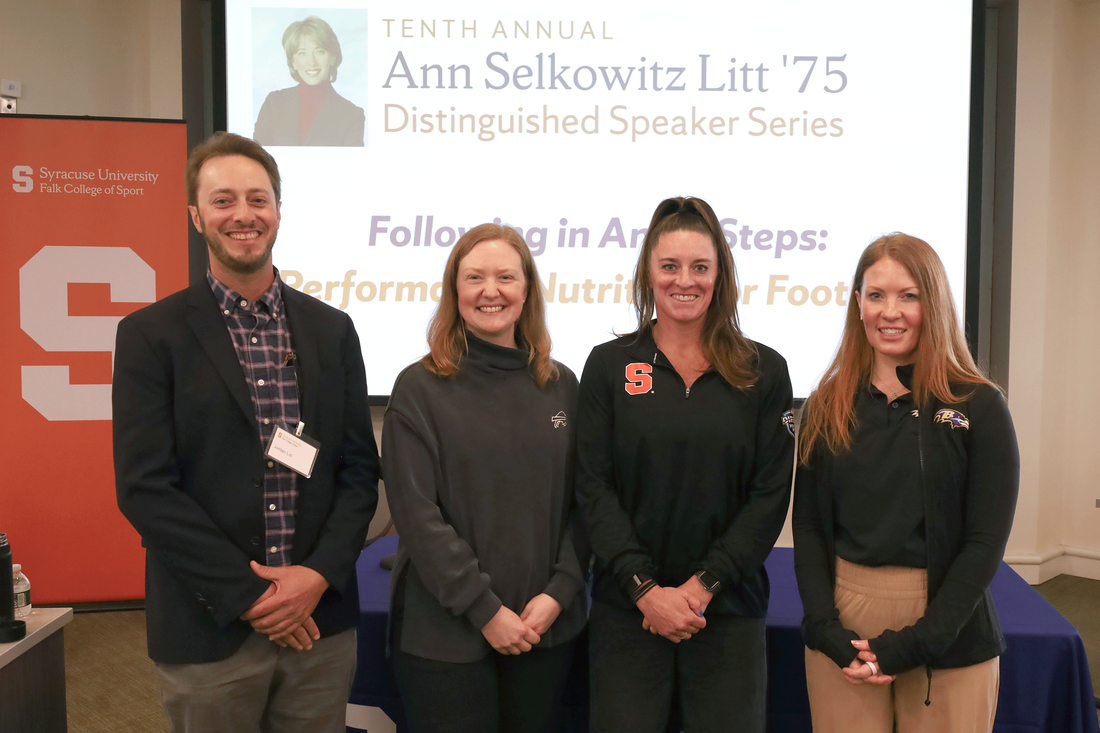
The three panelists from the 10th Ann Selkowitz Litt ’75 Distinguished Speaker Series join Jordan Litt, son of Ann Litt.
Advice to the Next Generation
Closing the formal session, each panelist offered a word of guidance to the students in the room.
Snyder urged openness to growth at every career stage. "I thought I had it figured out, and I did not," she said, reflecting on an earlier leadership role. "Now I'm in a space where: just teach me the things. I want to learn and I want to keep growing."
Zalewski was characteristically direct. "Don't be afraid to ask questions. Get your hands dirty. And know that it's not all glamorous. Food isn't always pretty."
Dziedzic challenged students to think beyond the marquee destinations. "This seems like the pinnacle of what you might want to do right now," she said. "But I would encourage you to think about, what do you want your life experience to be, not just your career? The places I've been, rather than the work I was technically doing, have really enriched my whole life."
She paused, then added: "Nutrition is still a very young science. There's so much we still don't know. And I think that makes this an unbelievable time to be in this field."