
The fruit salsa with apples, bananas, kiwi, honey, and strawberries–and to be scooped with cinnamon tortilla chips–had been placed before the judges.
Only this wasn’t a celebrity chef TV show. In this case, the judges were much more finicky–a classroom of third-grade students from Dr. Weeks Elementary School in Syracuse.
And the final decision? The fruit salsa is a keeper.
“9.0,” said one boy when asked to rate the salsa on a scale of 1 to 10. “9.5” a girl chimed in. “10.2!” exclaimed another boy.
And when asked about their favorite ingredient, one boy shouted, “All of it!”
On this early November morning at Dr. Weeks, the fruit salsa was made by the third-graders with help from Syracuse University students who participate in the award-winning Nutrition Initiative at the University’s Mary Ann Shaw Center for Public and Community Service.
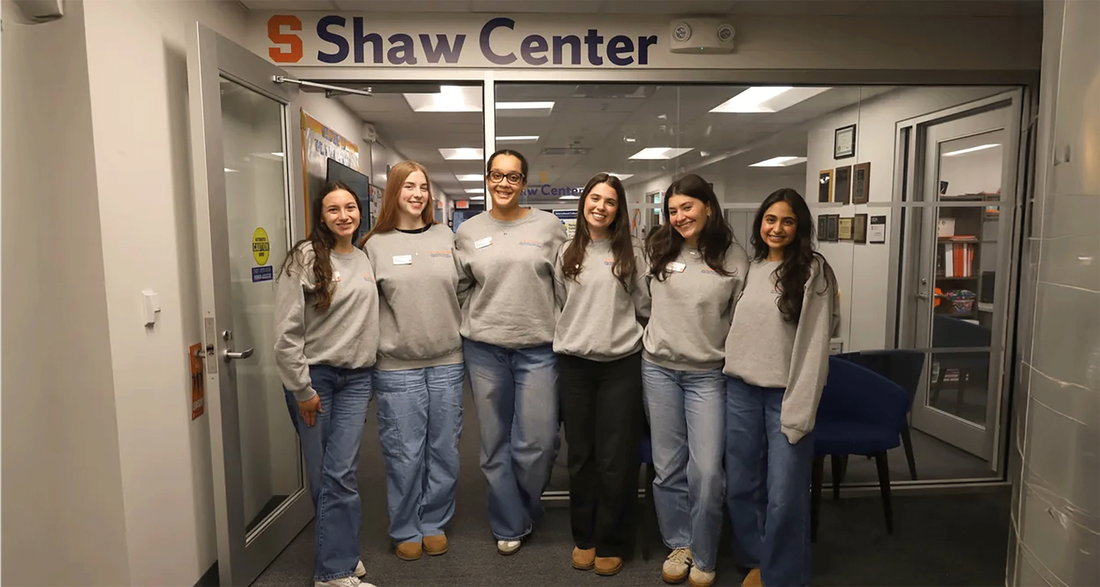
The fall Nutrition Initiative leadership interns included, from left to right, Tracey Rodriguez, Sophie Denham, Trinity Delgado, Lily Judelsohn, Mae Neuman, and Zoya Ansari.
The Nutrition Initiative is based in, and run by, the Shaw Center and funded by the David B. Falk College of Sport, which includes the Department of Nutrition as one its benchmark programs. The Nutrition Initiative consists of three programs: Books and Cooks, a literacy, culture, and cooking collaboration with Syracuse City School District elementary schools; Food Busters, a program for Syracuse high school students that explores the science behind food through hands-on activities and experiments; and Cooking on the Hillside, where Hillside employees in the Hillside Work-Scholarship Connection (HWSC) program provide cooking lessons to Syracuse high school students.
Shaw Center Assistant Director Carla Ramirez oversees a team of seven Nutrition Initiative leadership interns who create the curriculums, purchase and prepare food, and arrange travel for Nutrition student volunteers who participate in the program. The current faculty advisors from the Department of Nutrition– Associate Teaching Professor Chaya Charles (Books and Cooks), Associate Professor Margaret Althea Voss (Food Busters), and Associate Teaching Professor Maria Erdman (Cooking on the Hillside)–suggest and review lesson plans for the interns.
The leadership interns for the Fall Semester included Nutrition Initiative coordinator Zoya Ansari ’26 (nutrition science major), Trinity Delgado ’27 (exercise science in Falk College), Sophie Denham ’27 (neuroscience and psychology in the College of Arts and Sciences), Lily Judelsohn ’28 (nutrition), Natalie Kloman ’27 (nutrition); Mae Neuman ’27 (nutrition); and Tracey Rodriguez ’27 (nutrition science).
For the leadership interns, the common threads for joining the Nutrition Initiative are their fascination with nutrition, and their interest in giving back to the Syracuse community.
“Nutrition is important, especially for young children and teenagers to keep their bodies going and to maintain their health to prevent other problems,” Ansari says. “So going into these classrooms and teaching children nutrition is very important, and we’re doing it in a fun way that makes them excited about making food and trying it.”
Here's a closer look at each of the Nutrition Initiative programs:
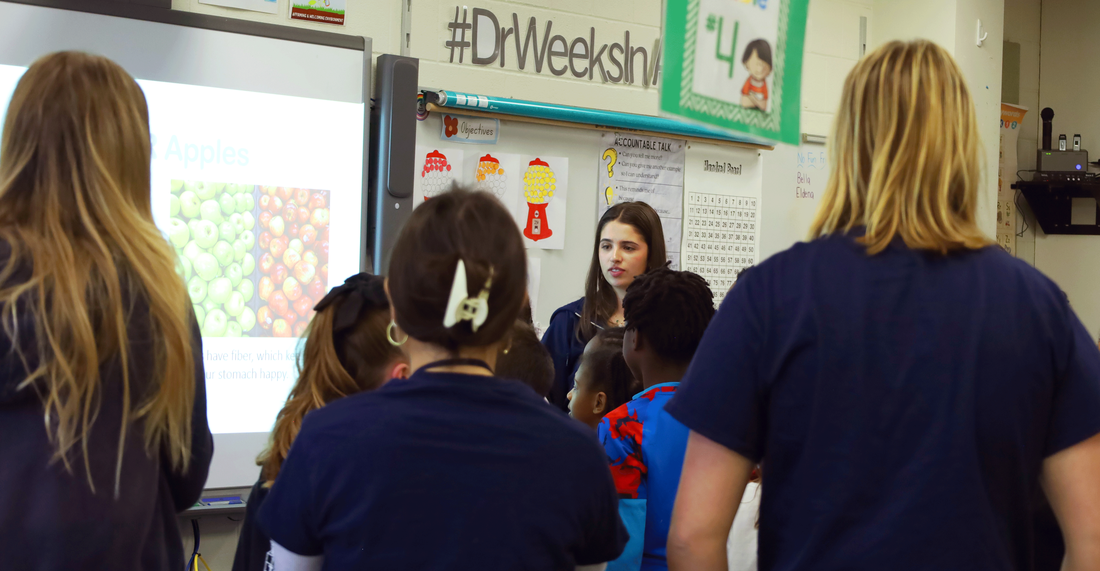
Leadership intern Lily Judelsohn conducts a “this or that” game with students from Dr. Weeks Elementary School
Books and Cooks
This fall, Books and Cooks was held in a third-grade class at Dr. Weeks and fourth-grade class at Ed Smith Pre-K-8 School. The curriculum was the same for both schools as each session focused on food from a different country and involved a different section of the MyPlate chart (fruits, vegetables, grains, protein or dairy).
Before deciding what countries to highlight, Charles says, the leadership interns ask about the native countries of students in the classrooms so they can best match the content with the students. In addition, Charles says leadership interns undergo training on nutrition education for those with disabilities so they can adjust their curriculums to meet the needs of students in inclusive classrooms.
On the day the children at Dr. Weeks made the fruit salsa, Judelsohn led a lesson on Mexico that included a discussion about the Día de los Muertos (Day of the Dead) holiday with clips from the Disney movie “Coco,” match games related to the discussion, and a “this or that” game (watermelon or kiwi–what’s better on a hot day?).
“They learn about the country, try to guess what they’re going to cook, and then they make the recipe and get to taste it,” says Dr. Weeks third-grade teacher Courtney Marx. “It’s hands-on, it’s engaging, they’re learning healthy habits, and since they’re the ones making it, they’re invested in trying it.”
Marx and co-teacher Mallory Chavez say their students get excited about Books and Cooks because of the individual attention they receive from the Syracuse University student volunteers.
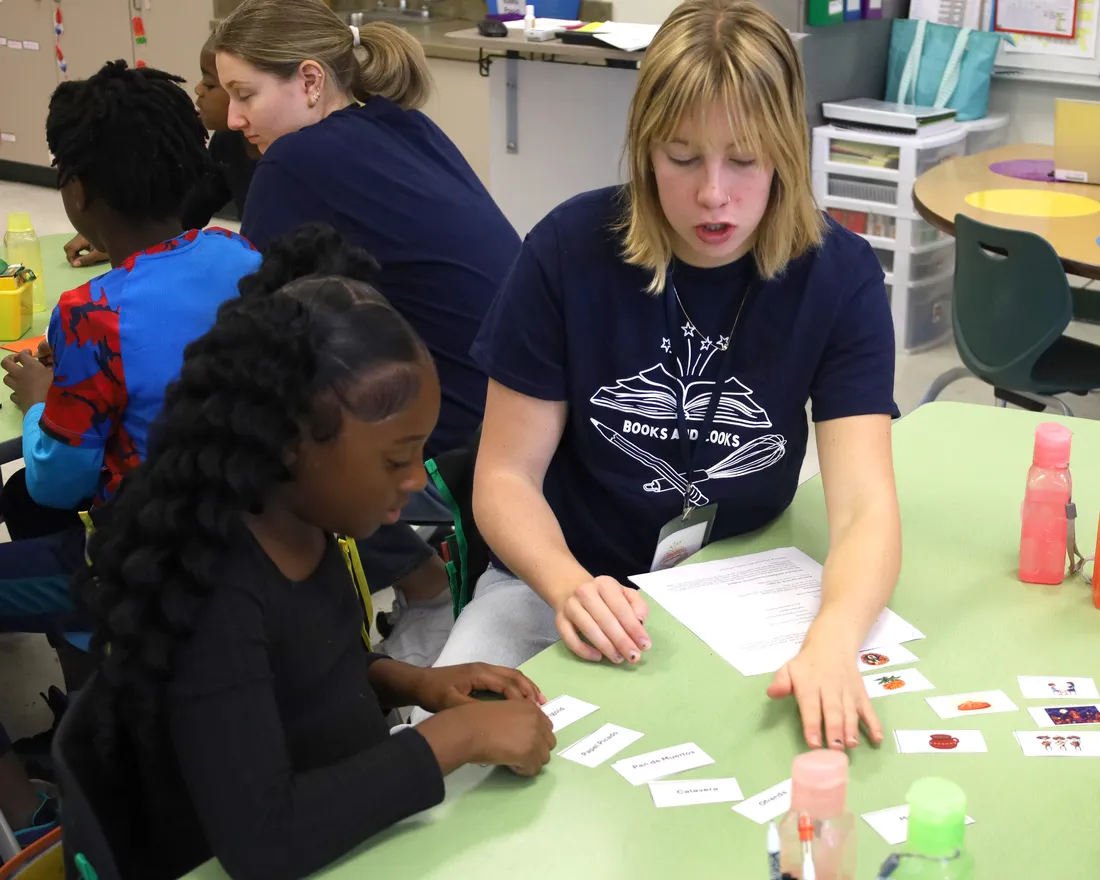
“The (Syracuse University) students who come in here are so engaging and our kids thrive in that environment,” says Dr. Weeks teacher Mallory Chavez.
“I think one of the biggest benefits is the adults who come in, because there’s an adult who works with every single group and that takes me and Mrs. Marx out of it and our students get to engage with other adults,” Chavez says. “It’s more of that 1-to-1 and the students who come in here are so engaging and our kids thrive in that environment.”
After volunteering at Ed Smith in the fall of 2024, Delgado became a leadership intern guiding sessions at Dr. Weeks in the spring and at Ed Smith this fall. Her class this fall includes many refugee students who are still learning English, and Delgado says she made sure she had enough volunteers to give those students extra attention so they didn’t feel isolated from their classmates during the program.
For one boy who was struggling with projects that involved reading and writing in English, Delgado replaced his projects with a coloring worksheet so he could still participate in the program.
“I love it. I love the kids, I love being able to see their smiles and that they’re actually looking forward to this, they want to learn,” Delgado says. “Being able to see the happiness they get from the simple things, that’s so rewarding for me, and I can ask for nothing more.”
At first glance, Delgado’s involvement with the Nutrition Initiative may seem odd as she’s an exercise science major who’s on a pre-med track to become a radiologist. But she enjoyed volunteering for the Special Olympics when she was in high school, and says her experience in the elementary school classrooms will help her relate to younger patients in her professional career.
“There’s a place for you in the Shaw Center because there are so many different opportunities and leadership interns,” Delgado says. “If you want to give back to the community or help someone who is trying to help give back to the community, it’s a great thing to do.”
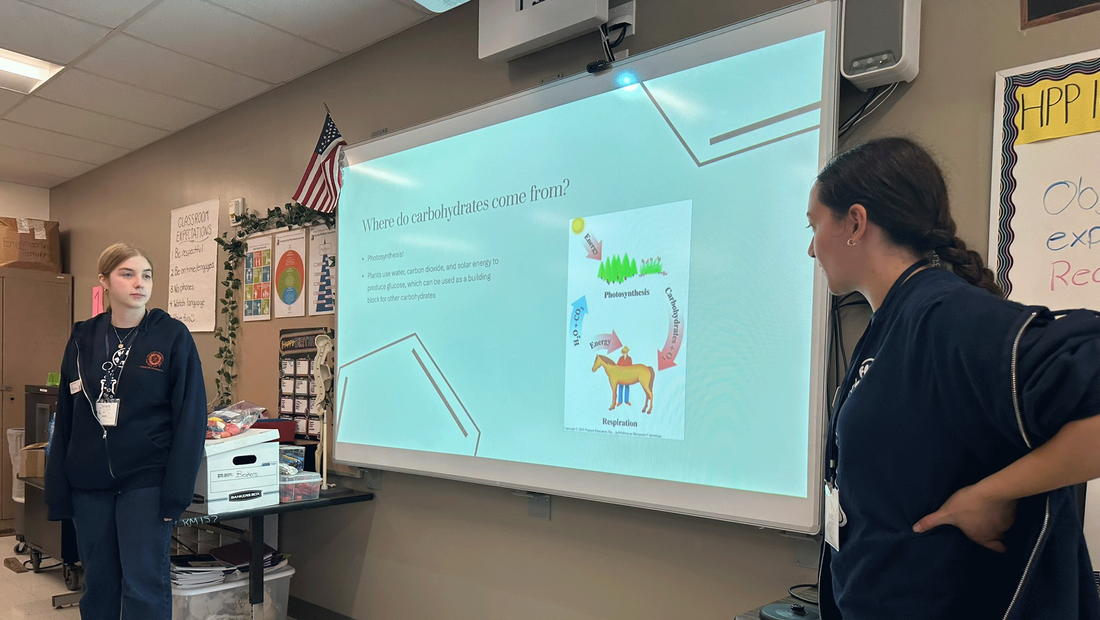
Leadership interns Sophie Denham (left) and Tracey Rodriguez discuss carbohydrates during a Food Busters’ program at Henninger High School.
Food Busters
What exactly is nitrogen ice cream?
A group of 30 sophomores from Henninger High School in Syracuse didn’t know, either, until they visited Falk College last spring to see the Syracuse University campus, discuss future educational opportunities, and watch a demonstration from leadership interns.
The demonstration involved pouring liquid nitrogen into a metal mixing bowl filled with an ice cream base while mixing it at a low speed. The Henninger students, who joined the Food Busters program because they’re interested in health professions, enjoyed a tasty way to learn about emulsification–a mixing process applicable to nutrition, food science, chemistry, and even biology.
Rodriguez, who along with Denham facilitated the Food Busters program at Henninger this fall, says the demonstrations are based on surveys with the students to see what they’re interested in learning.
“They’re very capable students and they know some of the science already, so we get to go a lot more in-depth about the science side of nutrition and we get to do cooler activities,” says Rodriguez. “They’re definitely more interested when it’s stuff they want to learn about.”
Food Busters, which was created in 2014 as the initial Nutrition Initiative program, received a Commitment to Action Award at the inaugural 2014 Clinton Global Initiative University Conference, and an Orange Circle Award in 2021 that “recognizes members of the Syracuse University community who have done extraordinary things in the service of others.”
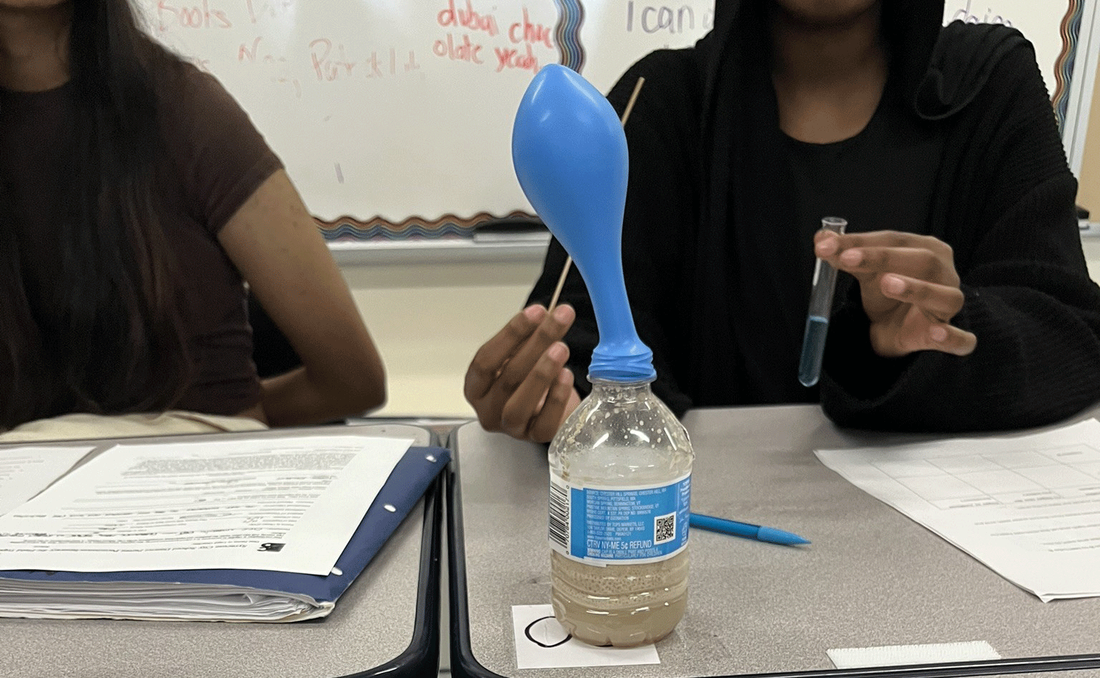
This Food Busters experiment exploring artificial sweeteners used the inflation of a balloon to show the carbon dioxide produced by yeast during fermentation.
Last winter and spring, Voss gave two presentations based on a thesis developed by last year’s Food Busters leadership intern, Lucy Olcott ’25, that focused on the Discipline Based Education Research methods used for Food Busters. The presentations were at the Syracuse University STEM Education Forum in January, and the Syracuse University Project Advance Professional Development Day for Teachers in May in New York City.
Olcott was a medicinal chemistry major and nutrition science minor who was a leadership intern for three years and is currently a Ph.D. student in pharmacology at the University of Pennsylvania.
“When I look back over the years in terms of the students that have been in those leadership roles, they are all of that quality,” Voss says. “And they go on to do fantastic (community service) work. Lucy is volunteering in a similar literacy program at the University of Pennsylvania this year, and she’s looking next year to continue in that type of leadership role.”
This fall, Rodriguez and Denham visited Henninger twice and their demonstrations involved extracting a strand of DNA from a strawberry, and an experiment that investigated artificial and natural sweeteners through yeast fermentation and Benedict’s solution (a chemical reagent used to test for the presence of reducing sugars). The first demonstration tapped into the students’ interest in DNA, and the second connected to many of their favorite foods and applications to healthcare and engineering.
Rodriguez, who wants to pursue a career in community nutrition, says Food Busters will grow in the spring with three visits to Henninger and a new partnership with the Institute of Technology at Syracuse Central high school.
“Nutrition education is important to any community, but in the city of Syracuse specifically, there’s a lot of food insecurity and there are a lot of areas with limited access to grocery stores and nutritious foods,” Rodriguez says. “We have the opportunity to teach kids about this at a younger age so when they get to a point in their lives where they can be responsible for their own nutrition, they will know more about what goes into it and how it can connect to their future careers.”
Cooking on the Hillside
All of the Cooking on the Hillside sessions are fun, but Week 5 in mid-November was particularly sweet–it was Dessert Day!
To start the classroom session with the mix of ninth- through 12th-grade students all from all five Syracuse City School District high schools, Neuman provided a baking pre-assessment worksheet for them to complete. Then it was off to the kitchen at Hillside’s HWSC campus in Syracuse to make waffle cones with ice cream, no-bake cookies, and an Oreo mug cake.
After spending about 45 minutes making-and eating-the treats, the students returned to the classroom to complete a baking post assessment that included questions such as “What is sugar’s role in baking?”
“It’s such a benefit for our students to work with Syracuse University students who are just a little bit older than them and pursuing their education and reaching for their dreams,” says Hillside’s Mariama McClain, manager of workforce development and programming for the HWSC program. “Those (Syracuse University) students bring their expertise and experience and they’re helping our kids experience something that may be new to them or different.”
Hillside is a not-for-profit agency that provides a variety of programs to Central New York youth and families. In the HWSC program, adult advocates in City of Syracuse high schools and middle schools identify students who can benefit from HWSC’s after-school mentoring and educational programs. As with the Henninger students, the Hillside students will end the spring semester with a trip to Syracuse University to learn about scholarship programs such as Say Yes Syracuse and visit the state-of-the-art Susan R. Klenk Learning Café and Kitchens in Falk College.
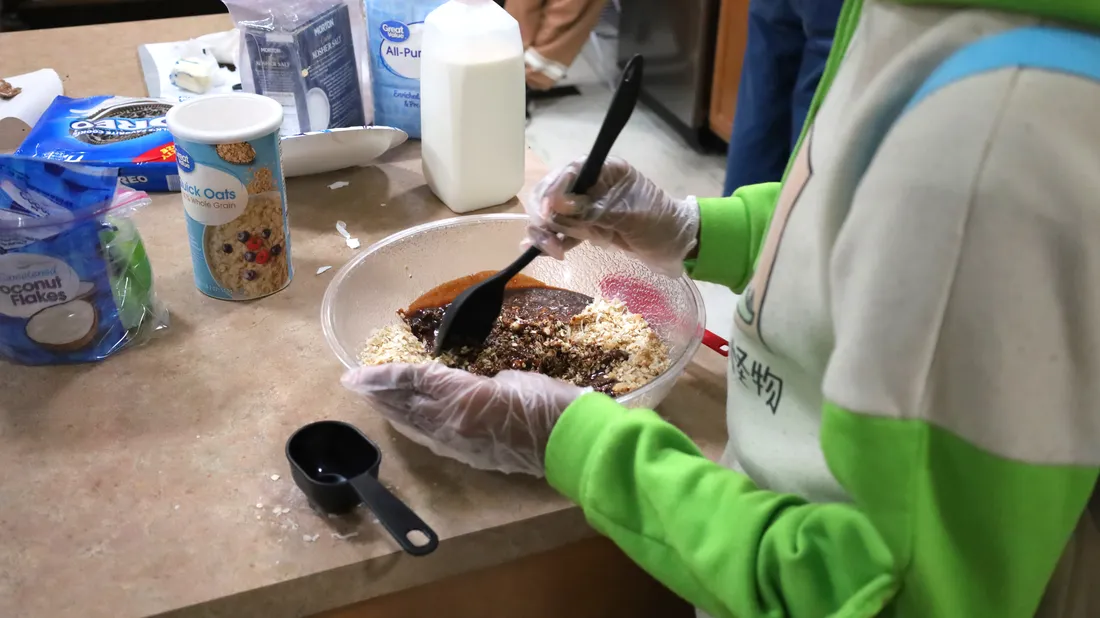
“Those (Syracuse University) students bring their expertise and experience and they’re helping our kids experience something that may be new to them or different,” says Hillside’s Mariama McClain.
“Sometimes our students may not have someone in their life who’s in college, so this (Syracuse University student) is the first person in college that they’re meeting,” McClain says. “Or it could be that they had no clue what they wanted to do, and hearing this other person’s story and how they figured out how to go to Syracuse is impactful.”
For Cooking on the Hillside this fall, Neuman and Ansari created the curriculum and recipes by asking the students what they wanted to cook, and referring to lessons from previous years to see what worked, what didn’t, and what they could expand. The students sign up for the program, so they already have some interest in cooking, baking, and nutrition.
“The (Hillside) volunteers do a great job of asking them questions about what they want to do in the future, and a lot of them want to go to college,” Ansari says. “Some of them want to be doctors, and some of them want to do something in nutrition, so this is a perfect way to coordinate everything together.”
Ansari says she wants to go to medical school following Syracuse and her three years with the Nutrition Initiative provided her with invaluable professional skills such as public speaking, time management, and organizing and motivating a large group of people. But like her fellow leadership interns, Ansari says the best part of the program is the opportunity to give back to the community.
“I know a lot of people like working with kids, and also just making food,” Ansari says. “Food is a great way to bring people together and that, along with working with children and teens and giving back to the community where they go to school, creates a nice experience for our students.”
The Nutrition Initiative and other Shaw Center initiatives are open to all Syracuse University students. For more information, visit the Shaw Center at 100 Sims Drive, sixth floor, fill out a volunteer interest form, or visit the Shaw Center table at the Student Involvement Fair. Visit the Falk College website to learn more about the academic programs offered in the Department of Nutrition.