
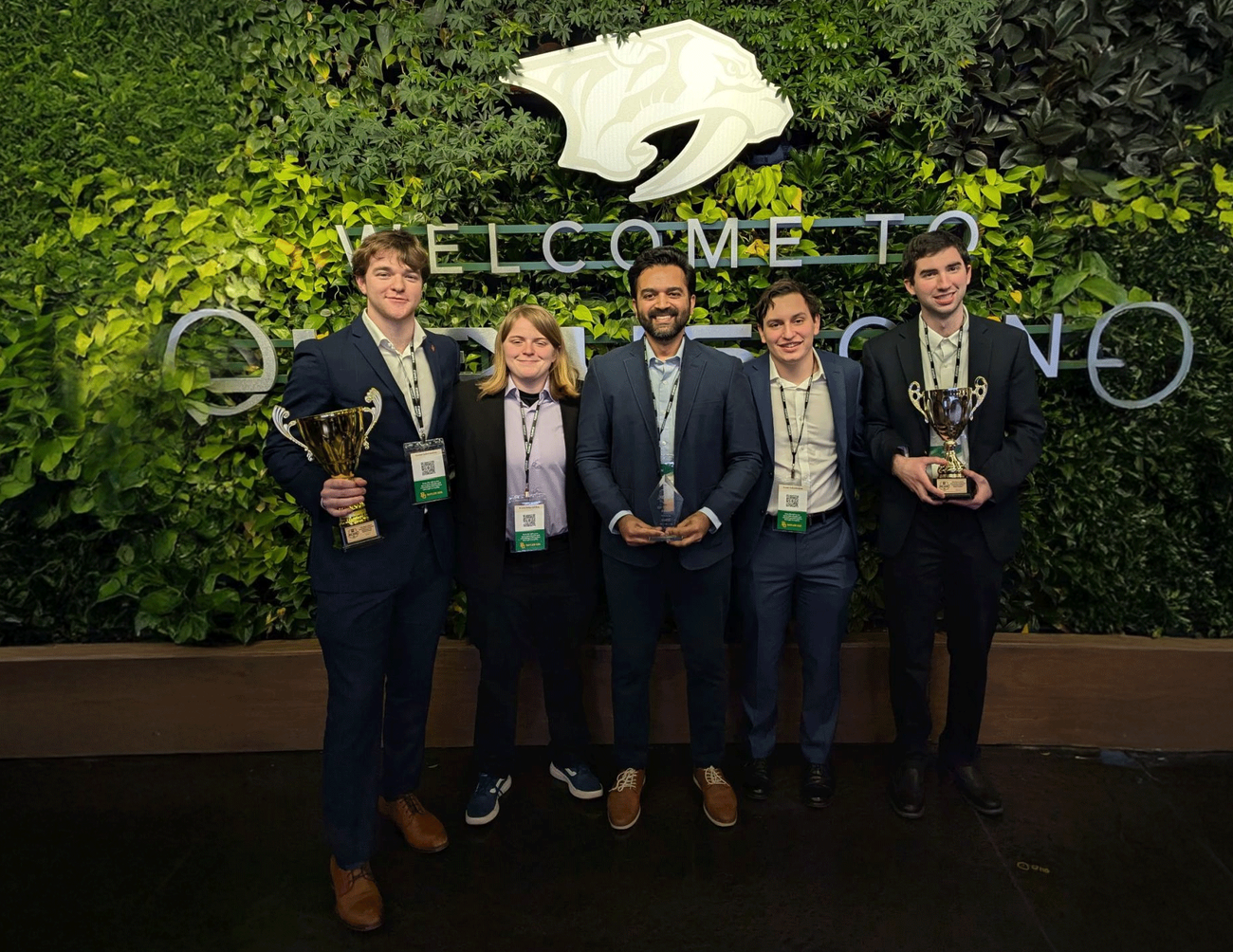
After years of podium finishes and back-to-back undergraduate team titles, the sport analytics program at Syracuse University’s Falk College of Sport has made winning at the National Collegiate Sports Analytics Championship (NCSAC) into a habit. This year, the program didn’t just return to the top—it dominated.
Senior Austin Ambler captured the overall undergraduate individual title, and the team of Ambler, Daniel Griffiths, and Daniel Baris claimed the undergraduate team championship, with all three landing in the top ten in overall points.
For the four Falk College seniors who made the trip, Ambler, Griffiths, Baris, and Jessica Fackler, the result was the payoff of a disciplined, collaborative preparation process built around one guiding principle: do the work before you ever step in the room.
“Winning the overall undergraduate individual title was incredibly rewarding,” Ambler says. “The competition featured so many talented and high-performing students, so being named first among them is something I’m truly proud of. It validates the hard work, preparation, and support system that went into getting to that moment. Representing Syracuse and Falk College means a great deal to me. Over the past four years, they’ve provided me with outstanding academic opportunities, mentorship, and hands-on experiences that helped prepare me for competitions like this. I’m proud to carry the Syracuse name and contribute to its tradition of excellence.”
All four students are sport analytics majors in the Falk College of Sport. Their preparation was shaped by weekly sessions with Assistant Professor Hassan Rafique, Ph.D., who led the group through practice data sets, varied prompt scenarios, and repeated five-minute presentation drills in the months leading up to the competition.
“This year’s team had strong analytical skills and was eager to discuss how to improve,” said Dr. Rafique. “The students were very engaged in discussing strategies to optimize their points. We had a good plan going into the first day of the championship. However, some delays and obstacles forced us to improvise, and the students did an amazing job of maintaining their composure and persevering throughout the day. The first day of the competition was almost a 12-hour day for the students.”
The consistent, rigorous, and iterative structure Dr. Rafique built mirrors his approach in the classroom. His teaching emphasizes not just technical proficiency, but the ability to communicate findings clearly and persuasively under pressure. In a competition where students have hours to work with an unfamiliar dataset and only minutes to present their conclusions to a panel of judges, that combination proved decisive.
“The weekly preparation sessions with Dr. Rafique completely changed how I think about data storytelling,” Griffiths says. “The check-ins and iterative feedback meant that by the time we got to competition weekend, we weren’t starting from scratch, we were refining. I only needed about 30 to 45 minutes to finalize my presentation because I was able to adapt a working version that had already been shaped through weeks of feedback. That preparation gave us a massive advantage compared to teams who were building everything last-minute.”
Fackler described a similar transformation in how she approached the competition’s core challenge.
“I originally had a completely different perception of what the competition was about,” she says. “Those sessions made me quickly realize I needed to pivot. They taught me that I needed one simple idea and basically sell it to the judges. That is what would make me most successful.”
“Our sessions with Dr. Rafique definitely helped prepare us,” Baris adds. “As someone who has been at that competition before and had a lot of success, he really helped us improve our skills related to data analysis and how to effectively and concisely communicate a story.”
Beyond the preparation, the Syracuse team arrived in Nashville with a collective strategy for the competition weekend itself. NCSAC features not only the signature presentation competition but also a series of side events and challenges, and the four students approached each one with intention.
“The team dynamic was both competitive and highly collaborative,” Griffiths says. “We pushed each other internally to be better, but we were also very intentional about optimizing how we worked together. At different points, we split into pairs or worked individually depending on where each of us could add the most value. In events like the Viral Competition, if one of us wasn’t confident in an answer, we would deliberately split up to maximize the chances of Syracuse still advancing. That balance of internal competition and strategic teamwork gave us a real edge.”
“We constantly worked together to optimize points and decide who was going to do what,” Fackler says. “We all were supportive of each other, especially when some of us would get knocked out of presentations in early rounds. Those people made sure to pick up the points in other places while the others were still presenting.”
For Ambler, the hours of weekly preparation paid dividends from the first moments of competition.
“I immediately felt my preparation click into place once the competition began,” he says. “Elements from my practice presentations translated directly into my final delivery, and having a strong foundation from the practice data, study guide, and weekly prep sessions allowed me to start confidently. This head start let me focus on refining and building upon my presentation rather than starting from scratch, which made a noticeable difference in my performance.”
For Baris, the competition’s most memorable moment came from watching his own growth across rounds. “What stands out the most to me is probably my presentation,” he says. “I felt like it improved every time I presented it as I got more and more comfortable.”
Griffiths found his most striking moment in the broader picture of what NCSAC represents. “The moment that stood out most was realizing, right before my presentation, just how diverse the field of sports analytics really is,” he says. “Seeing 50-plus students compete with backgrounds in marketing, engineering, business, fan engagement, it made the experience feel bigger than just the competition itself.”
“Beyond the win, I hope students leave with confidence that they can tackle complex, real-world problems and compete at a high level,” says Dr. Rafique. “Experiences like this teach far more than technical skills. They build resilience, teamwork, and the ability to communicate ideas clearly under pressure. Most importantly, I hope they see themselves not just as students completing a project, but as emerging professionals who can meaningfully contribute to the field of sports analytics.”
For Ambler, the championship is both a capstone and a launchpad. After graduation, he plans to pursue a master’s degree in applied data science.
“The sport analytics program has equipped me with both the technical skills—data analysis, modeling, and visualization—and the real-world experiences necessary to excel in an analytics-focused career,” he says. “It has given me a strong foundation to translate data into actionable insights and prepared me to contribute effectively in professional analytics roles.”
The advice the group offered to future sport analytics students speaks to how much the program shaped their thinking, not just technically, but competitively.
“Spend adequate time preparing,” says Baris. “Those of us who went into the competition with a baseline presentation already prepared definitely had more success. Also, just be confident in your abilities. The coursework and experience we have gained through Falk gives us a leg up on the majority of our competitors.”
“To get anywhere in this field, you need the technical skills to get you your analysis,” says Fackler, “but if you can’t convey them in an efficient and meaningful manner, you won’t be as successful as you may think you will be.”
Griffiths offered a final challenge to the next generation of Falk competitors. “It takes more than just coding and analytical skills to compete at this level,” he says. “It requires determination, adaptability, and the courage to make decisions under uncertainty. This competition is designed to identify future leaders in sports analytics. If that mindset excites you, then this is absolutely the competition for you.”