
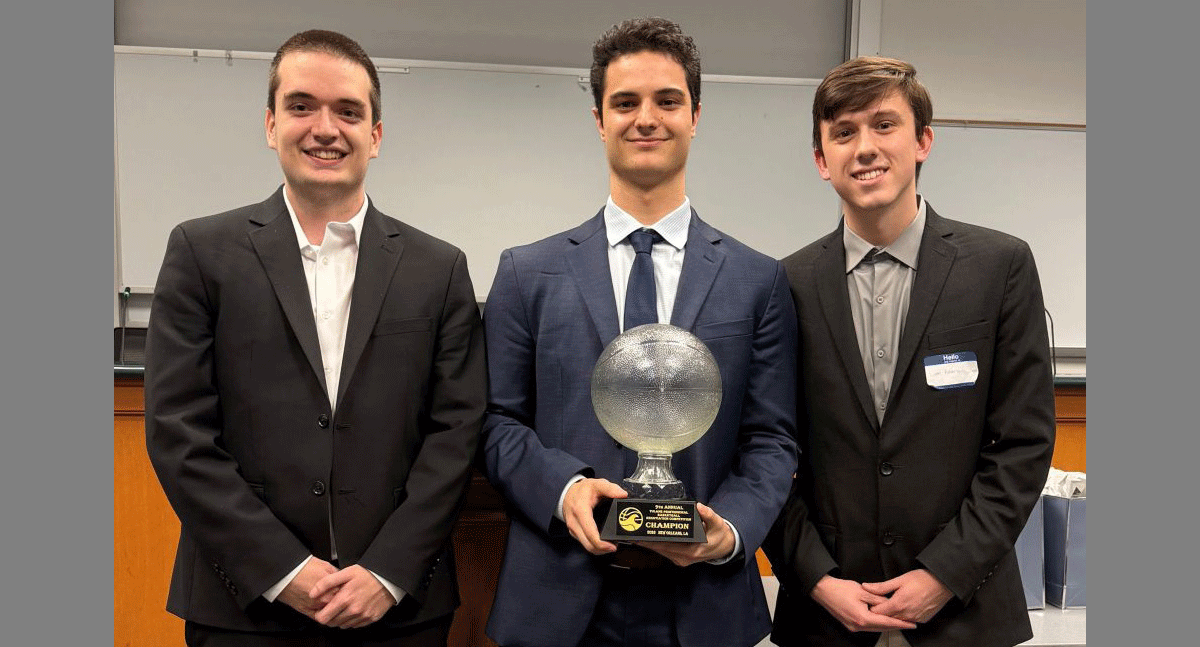
When three students studying sport analytics and sport management at Syracuse University’s Falk College of Sport arrived in New Orleans for the 9th Annual Tulane Professional Basketball Negotiation Competition, they stepped into a field populated largely by law students who had spent semesters studying contract language, negotiation strategy, and collective bargaining frameworks. Gavin Stein, Liam Roberts, and Sam Otley came with something different: a rigorous, data-driven approach to player valuation and a basketball-first perspective that, in the end, proved decisive. They left with the championship.
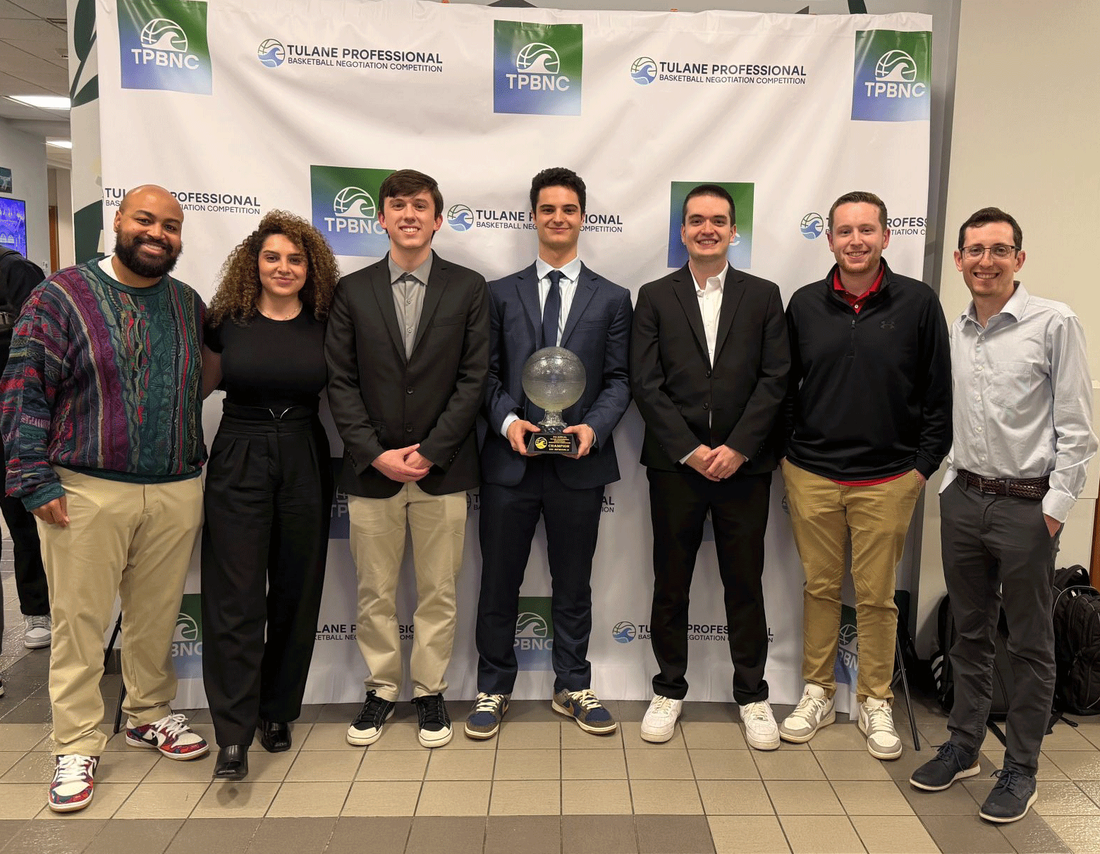
The winning team from Falk College poses with competition creators and those working in the NBA industry, including several Syracuse University alumni.
From left, Chris Robinson ’15, Niloo Abedzadeh L’23, Liam Roberts ’26, Gavin Stein ’26, Sam Otley ’26, Tyler Wasserman ’13, and Jackson Hett ’23.
The Tulane Professional Basketball Negotiation Competition (TPBNC), hosted by the Tulane Sports Law Society, is a simulated contract negotiation built around real-life scenarios and upcoming NBA free agents. Participants represent either a team or a player’s agent, guided by confidential objectives, while a judging panel drawn from across the basketball industry evaluates their work. It is one of the few competitions where analytics students and law students go head-to-head. For the competition’s founder, that intersection is precisely the point.
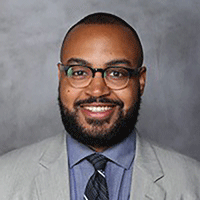
Chris Robinson ’15, creator of TPBNC
Built for the People Who Never Had a Roadmap
Chris Robinson — a Syracuse University alumnus and the creator of the TPBNC — launched the competition with a specific student in mind: someone who always wanted to pursue a career in basketball strategy but never knew how. Having worked on the team side of the business for most of his career, Robinson saw firsthand what separated candidates who could talk about basketball from those who could actually negotiate it.
TPBNC gives students the opportunity to learn everything that goes into negotiating an NBA contract from both the team and agent side, an experience that is not easily replicated in a traditional classroom.
Chris Robinson, TPBNC Founder & Syracuse University Alumnus
I wanted to do this competition because I believed it would give me the best opportunity to get a job working strategy in the NBA without a family member working for a team. I was told it’s connections or doing well at this comp that get you the jobs in this field.
Sam Otley
Sam’s preparation reflected that conviction. Over the prior 15 to 18 months, he had been independently building his own salary cap tables, studying Bobby Marks’ videos, and participating in mock trade deadline exercises at the ASU and SBC competitions. He worked through contract proposals reviewed by Syracuse University alumnus Preston Klaus — now a Basketball Strategy Analyst with the Indiana Pacers — and ran a full mock round with Gavin and Liam before traveling to New Orleans.
Liam Roberts described the team’s shared preparation approach: deep CBA study using Bobby Marks’ cheat sheet and resources like HoopsHype and HoopsRumors, combined with building a player similarity model for the virtual round. The quantitative frameworks at the core of the sport analytics curriculum gave the team a foundation that most of their law-school competitors did not have.
In the virtual round, our sport analytics background helped us with constructing a player similarity model, as well as presenting our ideas in a clean and concise way. In general, I feel our background gave us a unique edge in negotiating by using a more basketball-centric point of view, rather than a legal one.
Liam Roberts
For Gavin, the TPBNC had been a target since his freshman year. After competing in a prior edition, he returned this year with a clear benchmark in mind and a team he trusted. The preparation included mock situations, contract valuation frameworks, and the kind of analytical rigor that shaped their arguments across every round.
They get an incredible pool of basketball executives and agents to come judge, and rounds of basketball contract negotiations, for me, is a ton of fun.
Gavin Stein
The Championship Round: Two Hours, High Stakes
The most demanding moment of the competition came in the championship round, where teams were given roughly two hours to develop a complete trade strategy. That kind of negotiation that, in a real front office, would unfold over weeks or months. The time constraint was designed to test not just knowledge, but composure, trust, and collaboration under pressure.
Being given essentially two hours to develop a trade strategy that would unfold over weeks or months in reality was difficult to say the least. But we had already worked together as a group under similar circumstances at the ASU NBA Trade Deadline Competition, and I feel that having that experience collaborating with one another really helped with working under such a time constraint.
Liam Roberts
The team’s experience at the ASU Trade Deadline Competition earlier in the year had already taught them how to function as a unit under pressure. They knew each other’s strengths, trusted each other’s judgment, and could move quickly without losing coherence. The championship scenario was hard, but it was not unfamiliar territory.
Validated by the People Who Matter
Beyond the trophy itself, Gavin, Liam, and Sam spoke consistently about what the experience gave them at a deeper level: the validation that comes from having NBA professionals affirm the quality of your thinking. For students trying to break into one of sports’ most competitive industries, being challenged and complimented by people who have held those roles for decades carries a different kind of weight than any classroom assignment.
This competition helped instill a newfound sense of confidence in myself. The sports industry is obviously one of the most competitive industries to break into, and at times it can be draining. But to be congratulated and complimented by judges with years of NBA experience under their belt really gives a sense of belonging. Furthermore, the connections this competition provided me with have already been so valuable, and I cannot wait to continue having these meaningful conversations with the people I met.
Liam Roberts
I also learned that if you put in the work you should be confident in yourself. We kept performing well against law students because we put in the work beforehand and our confidence never faltered. I’m very fortunate to be with a program like Sport Analytics where they support me to go to competitions and experiences like this one.
Gavin Stein
Robinson has tracked that pipeline closely. Fifteen TPBNC alumni have landed full-time roles with sports organizations, and he described a direct line between strong competition performance and the attention of the decision-makers in the room.
My goal in starting the competition was to give students like myself, who always wanted to pursue a career in basketball strategy but never knew how, a platform to show what they know and get exposed to the decision makers who matter. I know in talking to judges that their organizations are always looking to add talent, and there is no better place to find an entry-level candidate for a basketball strategy position.
Chris Robinson
A Message to the Next Team
Asked what they would tell a Sport Analytics classmate who was considering the competition, all three were emphatic: go. Prepare for months, not weeks. Know the CBA deeply. And understand that the difficulty is the point — because everyone else in that room has done the work too.
If you want to work in basketball, going to this competition should be a top priority. Outside of Summer League, there is no better opportunity for students to interact with a wide variety of professionals working in the basketball industry. I would also tell them to come prepared because everyone at this competition knows their stuff, which gives you the opportunity to really impress those who are judging.
Sam Otley
If you’re interested then 100% go for it, there’s truly no better event for networking with basketball industry professionals than this. It’s difficult content and rules that you’re dealing with but with enough time and effort anything is possible.
Gavin Stein
Falk Sport Analytics | TPBNC Notable Alumni
Preston Klaus (MS ’23) — Indiana Pacers, Basketball Strategy Analyst
Niloo Abedzadeh (L ’23) — Toronto Raptors, Salary Cap Strategy Coordinator
Jackson Hett (MS ’24) — Chicago Bulls, Basketball Analytics Coordinator
Stay Connected
Keep up with what's happening through our Falk College email newsletter. From inspiring stories and groundbreaking research to events and community impact.